What is RSI?
RSI stands for Regular and Substantive Interaction, and refers to the frequency and quality of instructor-student interactions in fully-online courses. It is the responsibility of every online instructor to meet RSI requirements for each online course that they teach. They may do so themselves or with the help of a another instructor, instructional support staff, or their dean.
RSI can be broken down into three measurable components:
REGULAR | SUBSTANTIVE | INTERACTION |
FREQUENTLY AND CONSISTENTLY
| ACADEMIC IN NATURE, AND RELEVANT TO THE
| COMMUNICATION WITH AND BETWEEN STUDENTS, INITIATED BY THE INSTRUCTOR
|
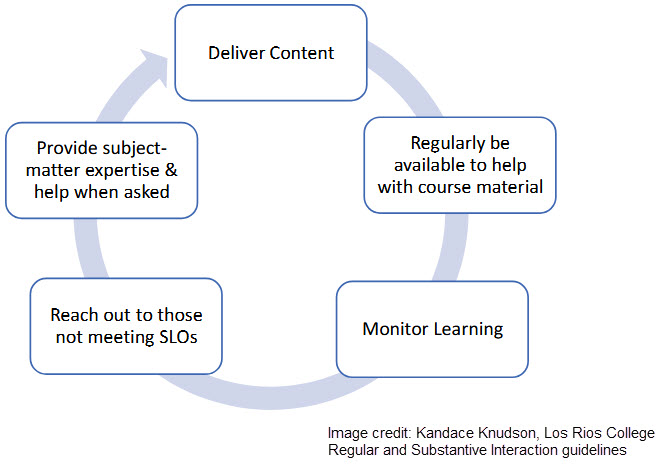
This is a visual description of the critical pieces that make up the new definition of RSI. It is presented as a weekly
cycle to reflect the USDE language and the regular and recursive nature of the teaching process.
Why is RSI necessary in online classes?
- It's the law.
RSI is a federal law (34 CFR Part 600), a state law (5 CA ADC § 55204) and an Accreditation requirement (ACCJC Policy on Policy on Distance Education and on Correspondence Education.) When colleges go through Accreditation, reviewers evaluate online courses to evaluate the frequency and quality of the instructor-student interaction happening in the course.
RSI is not optional. Faculty who teach online are required by law to interact regularly with their students about the content of the course they are teaching, and colleges are required to ensure RSI is occurring by monitoring online instruction. How that occurs is left up to colleges.
- decades of research connect it to student success.
RSI is not new - it is simply a new name for a set of pedagogical best practices that are widely accepted across every teaching modality. Decades of research have shown that student engagement and interaction in online courses are essential to student success. RSI has always been a key component of online certifications.
Though it may be tempting to think of RSI as an additional burden imposed on an already full faculty workload, ensuring that regular and substantive interaction occurs in all online courses aligns with our vision of ensuring students achieve their full education potential regardless of learning modality.
- it enables us to receive federal financial aid.
Regular, substantive interaction is what sets distance education apart from correspondence education.
Correspondence education is characterized by student submissions and assignment of grades, while distance education is characterized by the rich interaction students and teachers have in the online space. Students cannot receive financial aid for correspondence courses.
There have been cases where the Department of Education has sought hundreds of millions of dollars in financial aid reimbursements from colleges and universities when it was discovered that courses designated as distance education were actually being taught in a correspondence format because they lacked RSI.
- there are serious consequences if online courses do not meet the mandate for rsi.
Institutional compliance is required and non-compliance can have a variety of consequences, including fines:
- Individual disciplinary action for faculty and or staff
- Loss of the: ability to award federal financial aid to students
- Ability to serve U.S. military, veteran, or dependent students
- Ability to offer online education
- Ability to approve new courses and or programs
Some examples of fines being imposed:
- ED sought $713 million in federal financial aid reimbursement from Western Governors University after an audit report determined their courses did not meet the criteria (regular and substantive interaction) to be labeled distance education.
- ED determined in a federal audit that Saint Mary-of-the-Woods College improperly distributed $42 million in federal financial aid to students who were enrolled in similarly mislabeled distance education courses and the college was required to return the full amount.
- Scottsdale Community College’s request for 48 new online programs was denied approval by their Accrediting Commission due in large part to inconsistent online course standards and by a marked lack of faculty training for online instruction.
Simply put, to offer courses online, these are the things that must be done weekly:
- Deliver SLOs/course content
- Regularly be available in a scheduled time to help with course material and answer questions
- Monitor student success in learning course content
- Reach out to students you identify as needing support and help them learn the SLOs/course content
- Answer student questions and help them with course content and subject matter
What will an accreditation course reviewer be looking for in my online course?
The Accrediting Commission for Community and Junior Colleges (ACCJC) has created the Quality Continuum Rubric for Distance Education to answer that very question. It details four categories of Substantive interaction and two categories of Regular interaction, providing insight into how RSI can be implemented in ways that support both our students and our accreditation.
How do I make sure I'm meeting RSI requirements?
The Distance Education office offers several ways that faculty can assess their own courses to ensure that RSI requirements are being met:
- Make an appointment with the Instructional Designer to review your course and receive personalized recommendations.
- Participate in a 6-week Online Instructor Certification course where you will learn about RSI strategies as well as ...
- Review these helpful RSI guidelines created by faculty at SCC Los Rios
- Watch one of the @ONE webinars about RSI.
- Watch the Chancellor's Office webinar that includes a panel of experts from the ACCJC, ASCCC and DECO organizations. You can also view the accompanying FAQ document created to help answer questions posed by audience members during that webinar.
